> For the complete documentation index, see [llms.txt](https://docs.raybot.app/start/llms.txt). Markdown versions of documentation pages are available by appending `.md` to page URLs; this page is available as [Markdown](https://docs.raybot.app/start/web-app/web/signals.md).
# Signals
The **Signals** section is the web interface for configuring RayBot's core analytical features.
All the functionality runs in Telegram — **Signals** gives you a visual control panel for managing your settings, without bot commands or menus.
#### 🧩 What's inside Signals
* [**🆕 Multi Wallet**](/start/web-app/web/signals/multi-wallet.md) — get notified when multiple tracked wallets buy the same token.
* [**🧲 Accumulation**](/start/web-app/web/signals/accumulation.md) — track the position-building phase: receive one clear signal instead of dozens of scattered buy alerts.
{% hint style="info" %}
More RayBot features will be added to the web version over time.
{% endhint %}
### **🗂️ Interface structure**
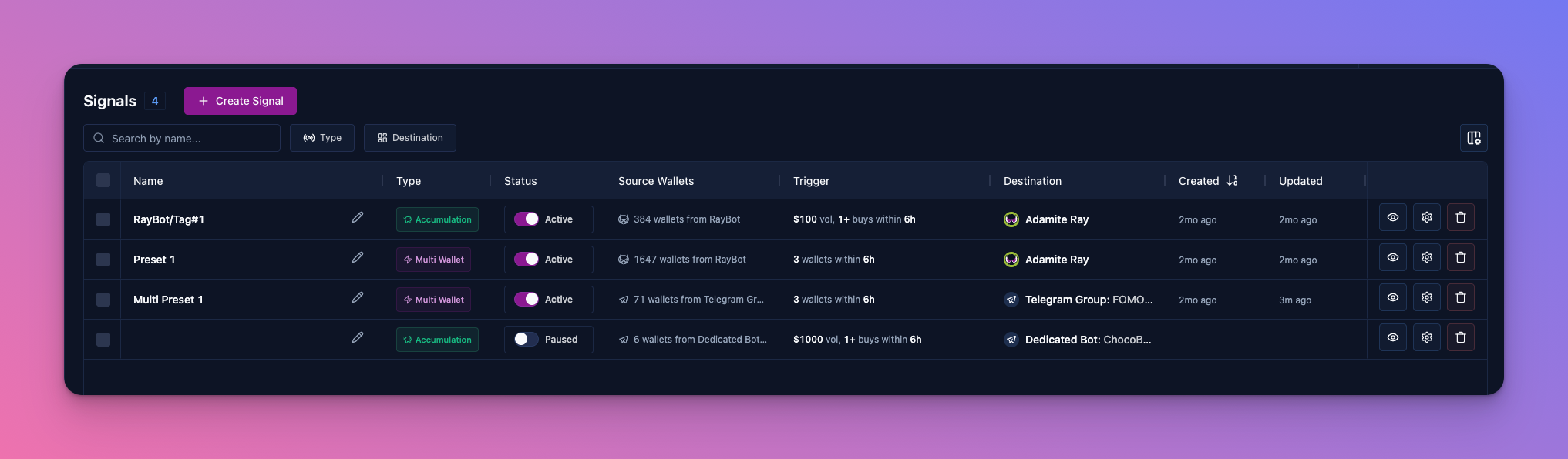
In this section you can view all your signals: which are active, which are paused, which wallets they pull data from, what conditions trigger them, and which Destination receives the notifications.
The table contains the following columns:
* **Name** — signal name.
* **Type** — signal type: Multi Wallet or Accumulation.
* **Status** — current status (Active / Paused).
* **Source Wallets** — wallets being monitored for activity.
* **Trigger** — the condition that fires the signal (volume, number of buys, time window).
* **Destination** — the bot or group where notifications are sent.
* **Created / Updated** — creation date and last update.
You can create new signals using the **+ Create Signal** button, as well as edit or delete existing ones.
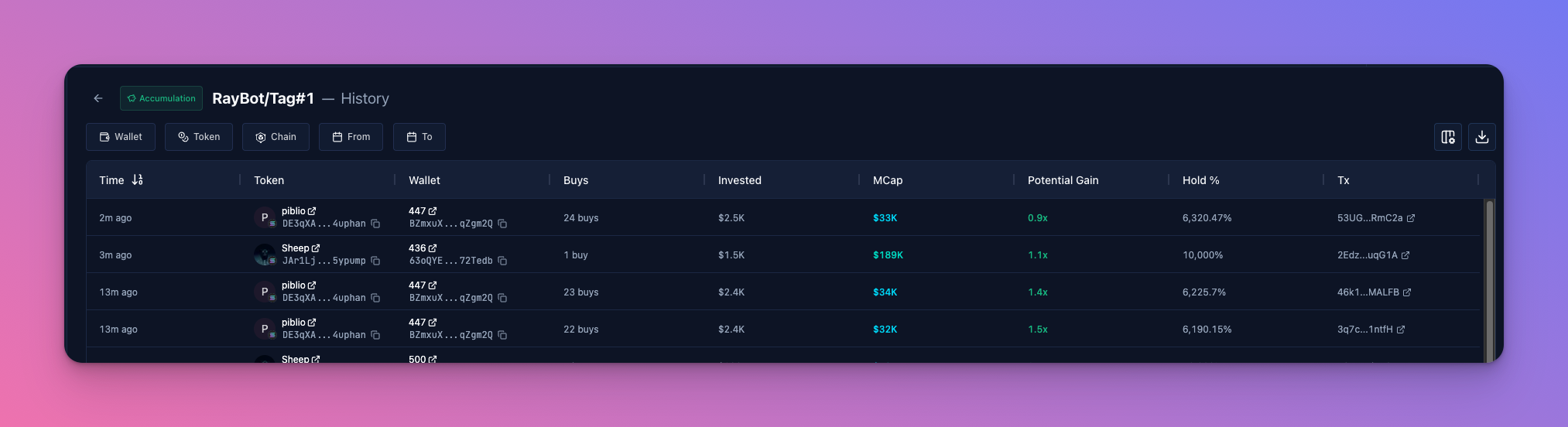
#### 👁️ Signal History
Click the 👁️ button next to any signal to open a full log of tokens that matched its conditions — including when it happened, which wallets were involved, how much was invested, the MCap at entry, and how the price has moved since.
The history can be filtered by wallet, token, network, and time range.
---
# Agent Instructions
This documentation is published with GitBook. GitBook is the documentation platform designed so that both humans and AI agents can read, navigate, and reason over technical content effectively. Learn more at gitbook.com.
## Querying This Documentation
If you need additional information that is not directly available in this page, you can query the documentation by asking a question.
Perform an HTTP GET request on the following URL with the `ask` and `goal` query parameters:
```
GET https://docs.raybot.app/start/web-app/web/signals.md?ask=&goal=
```
`ask` is the immediate question: it should be specific, self-contained, and written in natural language.
`goal` is what the user is ultimately trying to achieve, the reason they need the answer. Sharing it helps GitBook give you a better, more relevant answer. A goal is most helpful when it describes the outcome the user wants rather than restating the question. For example, with `ask=how do I create an API token`, a goal like `automate deployments from our CI pipeline` lets GitBook tailor the answer to that use case.
The response will contain a direct answer to the question and relevant excerpts and sources from the documentation.
Use this mechanism when the answer is not explicitly present in the current page, you need clarification or additional context, or you want to retrieve related documentation sections.